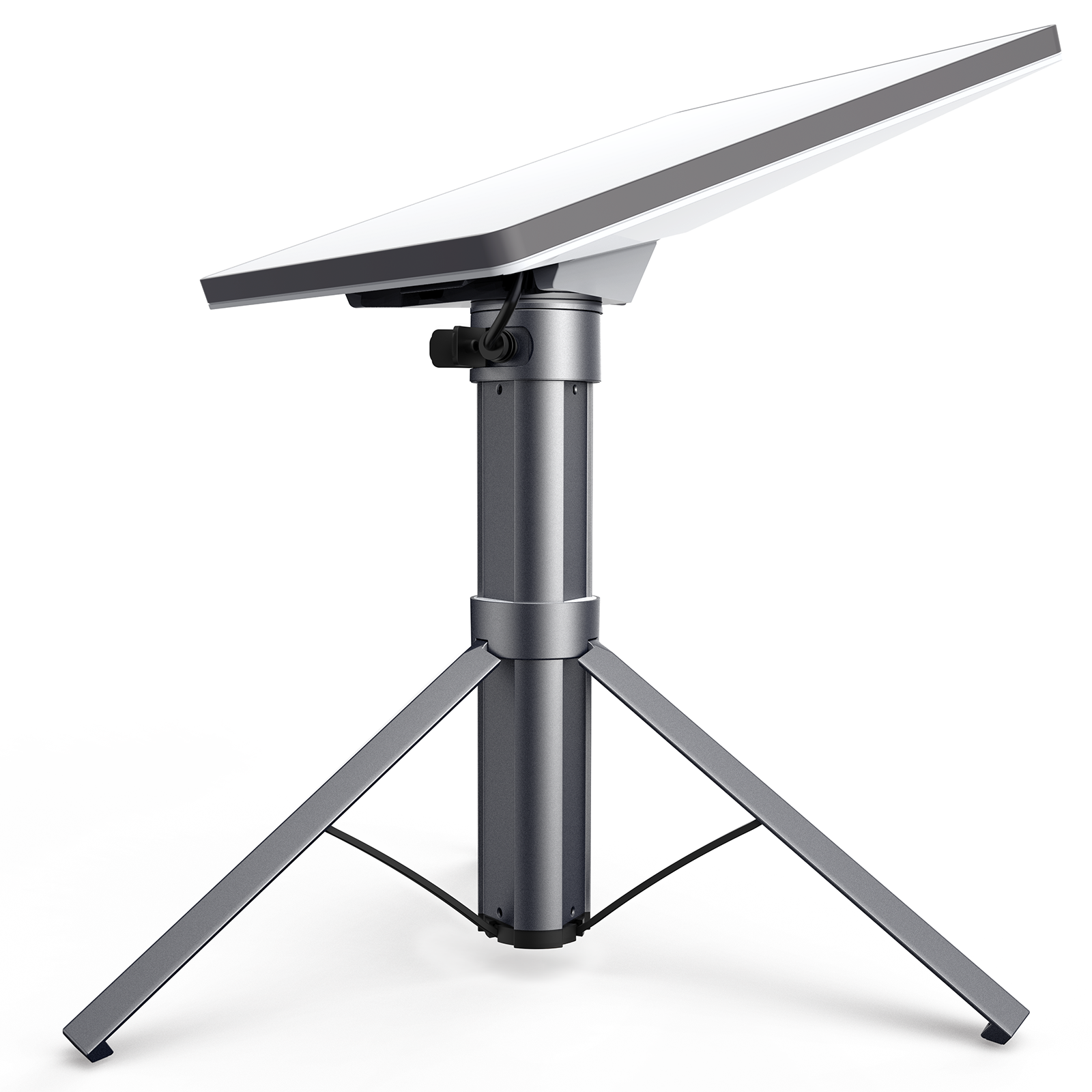
Starlink Mini Battery: Voltage, Runtime & Sizing Guide

Choosing a Starlink Mini battery is usually presented as a capacity question — how many watt-hours do you need. Capacity matters, but it isn't what makes a battery fail in the field. Voltage is.
There's a specific piece of misinformation circulating on this topic, including in Google's own AI-generated answers, that the Starlink Mini accepts 12V to 20V DC. It doesn't. Starlink's own specification sheet lists the input rating as 12-48V 60W, with average power consumption of 25-40W. That's a 36-volt window being reported as an 8-volt one, and it changes which batteries are actually suitable.
Here's how to size one properly.
Can the Starlink Mini run on a battery?
Yes. The dish is DC-native — it takes power through a barrel jack and doesn't need an inverter. There's no internal battery, so it draws live from whatever source you connect: when the power stops, the dish goes dark immediately.
That last point is the whole reason battery choice matters more here than on most gear. A phone with a dying power bank keeps working. A Starlink Mini with a dying power bank is offline.
How many watts does a Starlink Mini use?
Starlink rates it at 25-40W average. Owners measuring their own units with inline meters generally report steady-state draw at the lower end of that, with a brief spike at boot while the dish acquires signal.
For sizing, use 30W. It sits in the middle of the official range and leaves margin for cold weather and an obstructed sky view, both of which push draw up.
In our own runtime testing the dish behaves better than that — our packs consistently deliver about an hour more than 30W arithmetic predicts, which points to a clear-sky average nearer 25W. We still size on 30W, because the point of a runtime number is that it holds on the bad day.
How long will a battery run it?
The arithmetic is watt-hours divided by watts, minus 10-15% for conversion losses. At a conservative 30W that gives you a planning floor:
| Battery capacity | Conservative planning figure (30W) | What we measure on our own packs |
|---|---|---|
| 99Wh | ~2.9 hours | ~1 hour longer |
| 129.5Wh | ~3.8 hours | ~1 hour longer, up to 6 hours |
| 166Wh | ~4.9 hours | over 6.5 hours |
| 300Wh | ~8.8 hours | not tested by us |
| 500Wh | ~14.7 hours | not tested by us |
Our bench figures come out roughly an hour above the conservative math at these capacities, which implies a real-world average draw closer to 25W than 30W on a clear-sky day. We publish the conservative number anyway, because a cold morning or a partly blocked horizon will push draw back up and a runtime figure you can't hit in bad conditions isn't much use.
Note that we haven't tested the 300Wh and 500Wh rows — those are pure arithmetic, included so you can size a power station you already own.
Why does voltage matter more than capacity?
Because the failure mode isn't a battery that runs out. It's a battery that can't hold voltage under load, so the dish reboots. The Mini's window is 12-48V, and 12V sits right at the floor of it.
Run a 12V source through a long or thin cable and the voltage arriving at the barrel jack is lower than the voltage leaving the battery. Drop under the floor and the dish restarts. This is the most common cause of a Starlink Mini that appears to work briefly and then keeps cycling — and it's why anyone selling you a battery on capacity alone is answering the wrong question.
Our power banks output DC 30V, which sits well inside the 12-48V window with headroom at both ends. That's a design choice about voltage stability, not a bigger number for its own sake.
Can any USB-C PD power bank power it?
Sometimes — and the requirement is higher than most people assume. Starlink specifies a minimum of 100W, 20V/5A when using their USB-C to barrel jack cable.
That rules out a lot of power banks that look adequate on paper. A 100Wh bank rated at 65W output has the capacity to run the dish for a couple of hours and not the delivery spec to start it reliably. If you already own a 100W PD bank and the right cable, try it — we'd rather you knew that than bought hardware you didn't need. What a purpose-built pack buys you is the elimination of the cable run and the adapter, not the ability to do something otherwise impossible.
Does it need to be under 99Wh to fly?
For carry-on, yes, in practice. Airlines generally permit lithium batteries up to 100Wh in the cabin without approval, which is why 99Wh is such a common capacity — it's engineered to sit just under the line.
If you fly with your dish, that ceiling caps your runtime at roughly 2.9 hours per pack at 30W. Two 99Wh packs is the usual answer. If you never fly with it, the limit is irrelevant and larger capacities are strictly better value per watt-hour. Check your airline's current policy before travelling; these rules change and vary by carrier.
Clip-on pack or standalone power station?
A standalone power station wins on capacity per dollar and runs other devices. A clip-on pack wins on there being nothing to trip over.
Be honest with yourself about which problem you have. If the dish lives in one spot in an RV and you already own a power station, buy a good DC cable and stop there. If you reposition the dish several times a day — chasing sky view, moving between vehicle and campsite, working from different spots on a shoot — then every reposition with a separate power station means moving two objects and re-running a cable. That's the case a clip-on design is for.
How fast will it drain a car battery?
At 30W, a Starlink Mini draws roughly 2.5A at 12V. A typical 12V starter battery with 50Ah of usable capacity would run it around 20 hours in theory, but drawing a starter battery down far enough to matter risks not being able to start the vehicle.
Run it off the vehicle only with the engine running, or off a separate leisure battery. And note the voltage issue again: a starter battery under load sags toward the bottom of the Mini's window.
Can it recharge from solar?
Yes, if the panel and the pack are matched. At 30W continuous the dish needs roughly 720Wh per day for 24-hour operation, which is a serious solar budget. For the more realistic case — running the dish during working hours and recharging the pack in daylight — a folding panel in the 40W class recharges a 100-170Wh pack over a day of decent sun.
Our 40W foldable panel is built for that pairing, with both Type-C and DC output.
One more thing about weather ratings
Worth knowing because almost nobody mentions it: the Mini is rated IP67 only with the DC power cable and Starlink plug installed, and Starlink notes it is no longer rated IP67 with a standard RJ45 cable.
So if your setup is going to sit out in weather, the power connection is part of the seal. A power solution with its own IP67 rating and sealed ports keeps that chain intact; an unsealed barrel connector in the rain doesn't, regardless of how the dish itself is rated.
Our Starlink Mini power range runs from a 99Wh clip-on that clears the flight limit to a 166Wh all-in-one mount and power bank, all with DC 30V output and IP67 sealing.
See the Starlink Mini collection →
Liu is a Product Manager at Saunyoto, working on the Starlink Mini power and mounting line.
Starlink is a trademark of Space Exploration Technologies Corp. Saunyoto is not affiliated with, authorised by or endorsed by SpaceX. We make power and mounting hardware; we don't control satellite service performance, coverage or speed.